 Download slides
Ocean markets ease, but flexibility remains uneven
Published: Thursday, August 06, 2026 | 09:00 AM CDT
On this page
Softer demand does not mean the same relief everywhere
Earlier in the summer, front-loaded cargo pulled a meaningful portion of peak-season demand into May, June, and July. Now, booking momentum is slowing, rates are softening, and space is becoming easier to secure. But this is happening in parts of the ocean freight market, not uniformly.
Spot rates and bookings are easing particularly on eastbound Trans-Pacific services into the U.S. West Coast. Elsewhere, carrier network changes, container shortages, limited allocations, weather disruptions, and geopolitical risks continue to restrict shipper flexibility.
During the strongest part of the front-loading period, bookings on Trans-Pacific services into the U.S. West Coast were filling vessels three to four weeks in advance. Now, some services are filling only one to two weeks ahead. However, late-July typhoon-related disruptions in north and central China are still creating localized port congestion, vessel schedule changes, blank sailings, and increased rollover risk.
The broader market changes aren’t necessarily visible in vessel utilization yet. Many sailings remain full. But because bookings are no longer stretching as far into the future as they did during the front loading, it suggests some of the demand that drove earlier rate increases is beginning to ease.
The risk is reading that signal too broadly. Softer rates on one lane do not automatically mean capacity, routing options, or schedule consistency have improved across the ocean shipping network. Some lanes are moving back toward balance between supply and demand, while others remain constrained.
Shipper impact: August ocean freight conditions are easing selectively, making lane-by-lane planning more important than looking at broad market averages.
Network conditions are changing slower than demand
The Trans-Pacific market is showing the first signs of a post-front-loading adjustment. U.S. West Coast spot rates began softening in the second half of July, and booking lead times have shortened. But operating conditions have not fully normalized. In practical terms, shippers may see lower rates and improved booking flexibility before they see improvement in routing options, schedule reliability, or network performance.
Asia–Europe is moving in a similar direction. Spot rates to north Europe and the Mediterranean are expected to continue softening as demand normalizes, and the rollover backlog that persisted for several weeks is gradually unwinding. Improved space availability should reduce some of the rate pressure that built earlier in the season.
Still, this is not a broad reset. The U.S. East Coast and Gulf Coast remain more constrained than the West Coast. Demand is stronger on those services, additional vessel capacity remains limited, and Panama Canal draft and cargo weight restrictions continue to affect vessel utilization. Some carriers have also announced canal-related surcharges and restrictions on heavier cargo.
The same distinction applies to demand signals. Forecasts showing lower import volumes after July do not necessarily point to weaker consumer demand. Retail demand has remained relatively steady, but some import activity was accelerated ahead of potential tariff changes. That means the slowdown now may reflect a shift in shipment timing rather than a meaningful change in purchasing activity.
The data shows that June import volumes into the United States dropped from May's front-loading peak but remained above year-ago levels, indicating that import activity is moderating rather than collapsing. Demand remains relatively healthy by historical standards.
2023‒2026 U.S. container import volumes
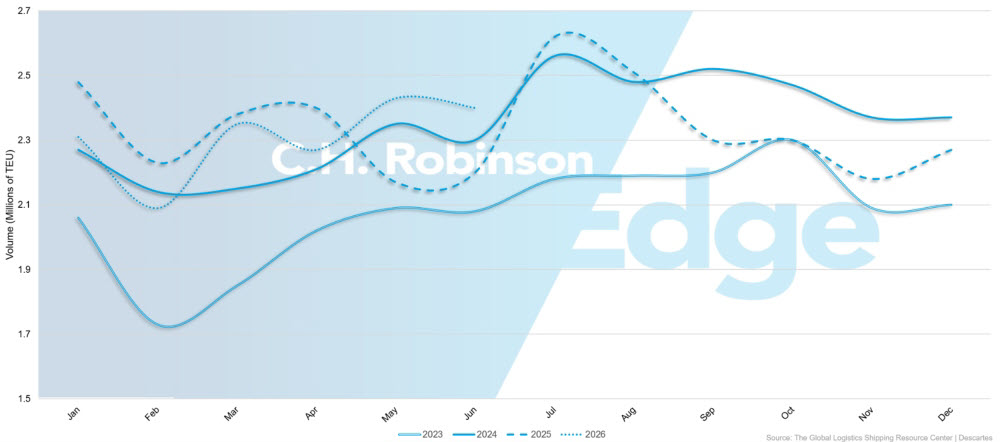
Shipper impact: Import volumes are moderating, but market conditions remain uneven. Shippers may find greater pricing flexibility on U.S. West Coast routings while East Coast and Gulf Coast services continue to operate under different supply-demand dynamics.
Network changes are creating new capacity constraints
In several markets, it’s the shape of the carrier network that’s tightening capacity for shippers.
Conditions on Trans-Atlantic westbound services provide one example. Mediterranean Shipping Company (MSC) is restructuring parts of its network, reducing some direct-service options and altering transit times on affected routings.
As those changes roll out, shippers may face temporary booking restrictions, re-bookings, or additional transshipment moves on some services. Whether or not capacity exists, the issue becomes whether the revised service structure still supports the port pair, transit time, and delivery window a shipper needs.
Asia export routings from North America show a similar issue. Congestion at major Asian transshipment hubs—including Shanghai, Singapore, and Port Kelang—has increased schedule disruption and reduced network reliability. As carriers adjust vessel deployments and service structures to manage those challenges, some direct-service options into Southeast Asia have been reduced or suspended.
Typhoon-related disruptions across north and central China are creating additional schedule volatility because of port omissions, blank sailings, and vessel bunching.
The Indian Subcontinent is the strongest counterpoint to the broader easing. Capacity remains tight on some services bound for North America and Europe in part because of carrier allocations—the amount of vessel space carriers are releasing for customer bookings.
On some Europe-bound services, carriers are releasing only a fraction of requested main-vessel bookings. Container shortages at inland depots and last-minute booking restrictions are also challenging. Securing space on preferred sailings often requires booking at least three weeks in advance.
Even as conditions improve in other trade lanes, network factors like these can still result in longer routings, additional cargo handling, or fewer direct sailings.
Shipper impact: Capacity may exist, but usable capacity depends on whether the available routing, timing, equipment, and allocation structure match your shipment plan.
External disruptions can still reshape the market
A softer demand environment does not remove operating risk. Weather, for example, is becoming a more significant factor as typhoon season develops across north and central China.
Carriers are adjusting service networks through schedule changes, port omissions, and blank sailings to minimize disruption. These changes are contributing to cargo accumulation, higher rollover risk, and vessel bunching at ports and terminals across both origin and destination locations.
Recent disruptions at major gateways such as Shanghai and Ningbo demonstrate how quickly weather events can create congestion and ripple through carrier networks. Recovery efforts are expected to take several weeks as terminals adjust to shifting vessel schedules. The resulting vessel bunching is also affecting terminal operations at both origin and destination locations. Even where space remains available, schedule reliability may be less predictable as carriers work through accumulated cargo volumes.
These risks do not mean shippers should ignore softening rate signals. They do mean shippers should separate price movement from operating flexibility. A lower spot rate may create a buying opportunity in one lane, while another lane still requires earlier booking, route validation, or contingency planning.
The strongest planning advantage for August and beyond may come from knowing where usable capacity has returned—and where service structure, allocation behavior, or external disruptions still limit what shippers can actually book.
What ocean freight shippers can do
- Read rate relief by lane. Softer pricing on some services does not mean booking flexibility has returned.
- Watch vessel utilization. While shorter forward-booking windows signal lower demand pressure, a sailing can still be full.
- Separate demand from service constraints. Despite lower demand in a lane, it may still have limited direct options, transshipment exposure, or allocation controls.
- Where allocation remains tight, plan earlier. Indian Subcontinent exports, some Trans-Atlantic routings, and U.S. East Coast or Gulf Coast services may still require longer lead times.
- Monitor routing, surcharge, and schedule risk. Panama Canal restrictions and surcharges, blank sailings, and typhoon-related congestion can affect transit times, reliability, and total landed cost even where base ocean rates are moving lower.
Why Middle East supply-chain recovery may take longer than expected
At the time of publication, many ocean carriers are still not transiting the Strait of Hormuz, Red Sea, or Suez Canal and continue to plan around the diversions and disruption-related surcharges introduced during the past year. While the possibility of a broader return to traditional routings in the Middle East remains a focus for the industry, carrier networks are still operating as they have for much of the year.
If regional conditions stabilize, it would be a positive development for global ocean networks. Shorter routings could eventually reduce transit times and create more flexibility across some trade lanes, while allowing carriers to move more cargo with the vessels already in service.
Restoring service at scale would take time though. Carriers have spent months adjusting networks for longer routings. Even if conditions improve, those operating decisions are unlikely to change immediately. Carriers would still need to review safety conditions, insurance requirements, vessel deployment, container positioning, and service restoration plans before making major network changes.
Transportation costs may also adjust more slowly than routings. Emergency fuel surcharges and other disruption-related fees imposed when the military conflict with Iran broke out in February would not likely end immediately, especially if carriers are still recovering costs tied to longer routes, higher fuel prices, and added operating risk. That means some transportation costs could remain elevated even if conditions in the region begin to improve.
For the remainder of the third quarter, the most meaningful indicator of progress will be whether carriers are in a position to begin adjusting routings, transit times, service offerings, or surcharges. Those changes would provide a clearer indication of supply-chain recovery than geopolitical developments alone.
Shipper impact: Regardless of news reports on Middle East negotiations or day-to-day conditions, shippers should continue planning around current network conditions and validate lead times, routing options, and surcharge exposure before changing transportation plans or budgets.
Notable shifts this month
Asia–Southeast Asia: Direct service coverage is changing
Carrier network changes continue altering routing options into Southeast Asia. The Ocean Alliance is canceling its Asia–North Europe 5 (AWE5) and Southeast Asia 2 (SEA2) services, removing direct service to Singapore.
MSC also suspended service to Belawan, Indonesia, and Jakarta, Indonesia, because of congestion and operational challenges.
For shippers moving cargo into Indonesia, Malaysia, the Philippines, Singapore, or Thailand, direct-service availability may warrant closer review as route structures evolve.
Shipper impact: Direct-service options into parts of Southeast Asia may be less dependable, making route validation more important before booking.
Indian Subcontinent–Europe: Bookings are limited
The Indian Subcontinent–Europe lane remains one of the tightest ocean markets. Only 30%‒40% of requested bookings are being released for main-vessel sailings. Booking guidance remains at least three weeks in advance to secure preferred sailings.
One of the main impacts is having fewer workable options when plans change. With fewer bookings being released and container shortages across several inland locations, last-minute cargo can be difficult to place. Compared with other trade lanes where booking flexibility has started to improve, shippers moving cargo from the Indian Subcontinent into Europe have less room to accommodate late orders or changes in demand.
Shipper impact: Earlier booking remains important for Indian Subcontinent–Europe freight, especially when inland equipment availability or preferred sailing windows matter.
Europe–North America: Market conditions vary more by origin
Booking conditions are beginning to diverge in Europe. Demand from northern Europe remains stable despite the traditional summer holiday period, while western Mediterranean volumes are expected to slow as seasonal production shutdowns begin. Eastern Mediterranean origins, particularly Türkiye, remain considerably tighter because of higher vessel utilization and fewer available service options.
This means what works in one part of Europe may not work in another during the remainder of the summer. Freight moving from Türkiye may require different lead times and routing strategies than cargo originating in Italy, Spain, or northern Europe.
Shipper impact: European shipping strategies may need to be more specific by origin market, especially where service options and summer production patterns are moving in different directions.
South America–United States: Export demand may begin diverging by commodity
New U.S. tariffs are expected to affect some Brazilian export sectors more than others. While several major commodity exports remain exempt, products such as wood could face additional pressure in the months ahead.
For ocean shippers, that may create a more uneven export market than earlier this year. If volumes decline in affected sectors while exempt commodities remain stable, demand for vessel space and equipment may no longer move in parallel. Shippers moving products affected by the new tariffs could encounter different booking conditions than exporters shipping agricultural or commodity-based cargo.
Shipper impact: Commodity mix may become a more important planning variable on South America–U.S. exports if tariff exposure changes shipment timing or volume patterns.
How ocean freight shippers can prepare for the month ahead
- Monitor booking windows alongside rates. In several trade lanes, booking lead times are shortening before vessel utilization visibly changes. That may provide an earlier signal of shifting market conditions than rates alone.
- Compare gateway conditions separately. Improving space availability and softer rates on U.S. West Coast do not guarantee similar conditions on the U.S. East Coast or Gulf Coast. Routing decisions may have a greater impact on cost and service than broader market trends.
- Validate routing options, not just available capacity. Service restructures, transshipment dependency, and changing carrier networks can alter transit times and service reliability even when space is available.
- Plan further ahead on constrained export trade lanes. Parts of the Indian Subcontinent–Europe market and some Trans-Atlantic services continue to require longer lead times and offer less flexibility when orders are booked close to departure.
- Book earlier on Trans-Pacific routings affected by typhoon hangover, vessel schedule changes, and Panama Canal restrictions.
- Maintain contingency plans. Middle East developments, Panama Canal restrictions, weather, and congestion at transshipping ports can affect sailing schedules, transit times, and surcharges.
- Evaluate inventory and replenishment plans carefully. Some of the anticipated decline in import volumes may reflect cargo that moved earlier in the year rather than a significant change in consumer demand, making demand signals more difficult to interpret.
 Actionable freight insights