 Télécharger les diapositives
La volatilité du prix du diesel augmente les coûts de transport en Amérique du Nord
Publié: jeudi, juin 04, 2026 | 09:00 CDT
Marchés des carburants : les perturbations se transforment en une pression durable sur le système
Les marchés de l'énergie continuent de s'adapter, non pas à ce qui a d'abord été considéré comme une perturbation due à un nouveau conflit militaire au Moyen-Orient, mais à une période prolongée de déséquilibre de l'offre. Au-delà des chocs d'offre immédiats, le marché est défini par des réductions durables des stocks, une reprise inégale des flux de pétrole et de gaz et des pénuries de produits raffinés.
La dynamique générale du système est de plus en plus déterminée par les stocks. Les stocks mondiaux de pétrole ont continué à se réduire au cours du mois de mai, constituant le principal mécanisme permettant d'absorber l'impact de l'interruption des approvisionnements au Moyen-Orient. Au fur et à mesure que ces tampons se réduisent, le système devient plus sensible à toute contrainte supplémentaire de l'offre ou à tout pic de la demande. Cela marque une évolution claire vers une nouvelle phase où l'épuisement des stocks est la principale variable de risque qui détermine les prix, la disponibilité et la volatilité.
Les prix du diesel aux États-Unis se sont stabilisés en mai, après des pics antérieurs, mais cette stabilité masque un déséquilibre sous-jacent entre l'offre et la demande. Les stocks américains restent inférieurs à la normale tandis que la demande d'exportation continue d'augmenter, les marchés mondiaux achetant davantage de barils nord-américains. Il en résulte un passage d'une forte volatilité des prix à un plancher de coûts durablement élevés. Pour les transporteurs, la pression est moins liée à des variations soudaines de prix qu'à une compression durable des marges due à l'augmentation des coûts du carburant. Pour les chargeurs, la pression vient des hausses de carburant prévues dans les contrats de fret.
Dans le même temps, les marchés du kérosène sont entrés dans une phase de perturbation plus aiguë. Les stocks européens ont continué à diminuer en mai, approchant les seuils critiques, et les compagnies aériennes ont réagi en réduisant leur capacité. Ce qui n'était qu'un signal d'alarme se traduit aujourd'hui par des conséquences opérationnelles, notamment des réductions de vols et des ajustements d'horaires. Les régulateurs considèrent de plus en plus le carburant aviation comme le risque d'approvisionnement le plus immédiat, ce qui renforce le fait que le carburéacteur devance le diesel en tant qu'indicateur principal des tensions plus générales sur le marché des carburants.
Les marchés des combustibles marins affichent une dynamique différente. Alors que les prix restent élevés et très volatils dans toutes les régions, les principaux centres de ravitaillement en carburant constatent un certain fléchissement des prix parallèlement à une baisse des volumes de carburant, ce qui suggère que les coûts plus élevés commencent à freiner l'utilisation des carburants. Il ne s'agit pas d'un retour à l'équilibre, mais plutôt d'une forme précoce d'ajustement du marché, les compagnies maritimes réduisant activement l'utilisation par le biais de vitesses plus lentes, de changements d'itinéraires et de gains d'efficacité opérationnelle. La pression sur les coûts demeure, mais elle est de plus en plus liée aux décisions prises par les réseaux.
Ce qu'il faut surveiller à l'avenir
- Même si les flux de pétrole et de gaz traversant les principaux points d'étranglement commencent à se normaliser, les chaînes d'approvisionnement physiques mettront des mois à se rééquilibrer en raison du réacheminement, des coûts d'assurance élevés et de la réduction de la capacité de raffinage.
- Le niveau des stocks de pétrole restera le signal le plus important à surveiller, car une réduction continue des stocks pourrait entraîner une nouvelle flambée des prix à l'approche du pic de la demande estivale.
- Les marchés du kérosène doivent être surveillés de près en tant qu'indicateurs précoces de la tension du système, car les perturbations de l'aviation ont tendance à se manifester avant les impacts plus larges sur le fret.
- Le resserrement durable de l'approvisionnement en diesel et les coûts élevés du carburant marin sont de plus en plus intégrés dans la tarification des contrats, ce qui signifie que les pressions sur les coûts persisteront indépendamment des mouvements de prix à court terme.
Tendances des carburants en Amérique du Nord
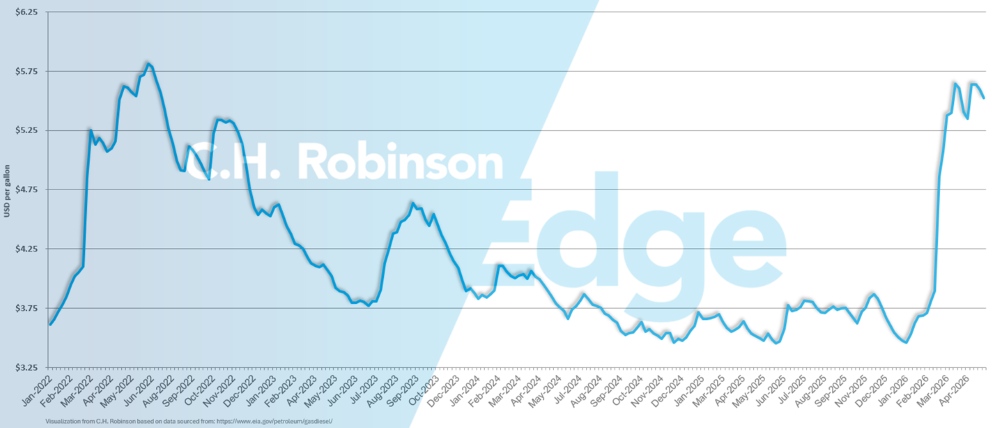
Le prix moyen du gallon de diesel aux États-Unis était de 5,60 dollars en mai, contre 5,50 dollars en avril. Outre l'augmentation du prix d'un mois sur l'autre, le prix moyen est également plus élevé que le prix du gallon en mai 2025, qui est de 3,50 dollars. Il s'agit du deuxième mois où les prix du diesel sont les plus élevés jamais enregistrés. Il convient de noter que la tendance de la seconde moitié du mois de mai était à la baisse, les prix du diesel terminant le mois à 5,52 dollars le gallon.
Prix moyen du gallon de diesel aux États-Unis
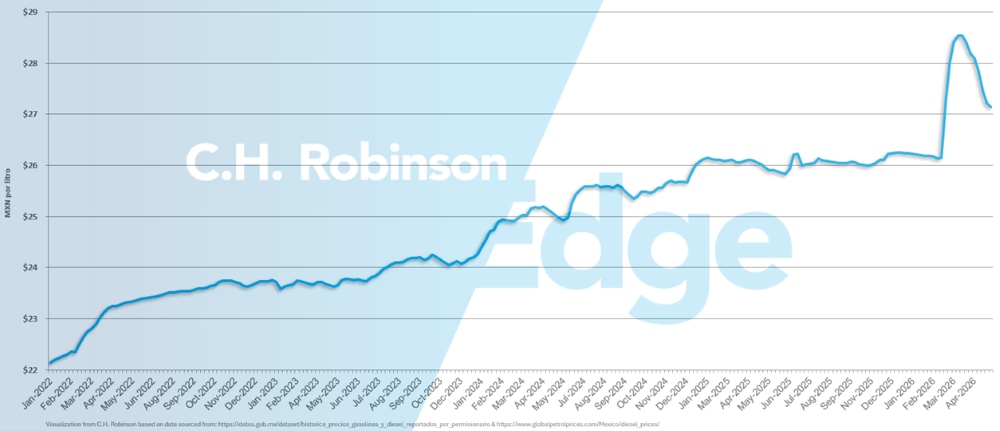
Le prix moyen national du diesel au Mexique, indiqué ici en pesos mexicains par litre, a baissé à près de 27 pesos au cours des dernières semaines, mais reste historiquement élevé.
Prix moyen du gallon de diesel au Mexique
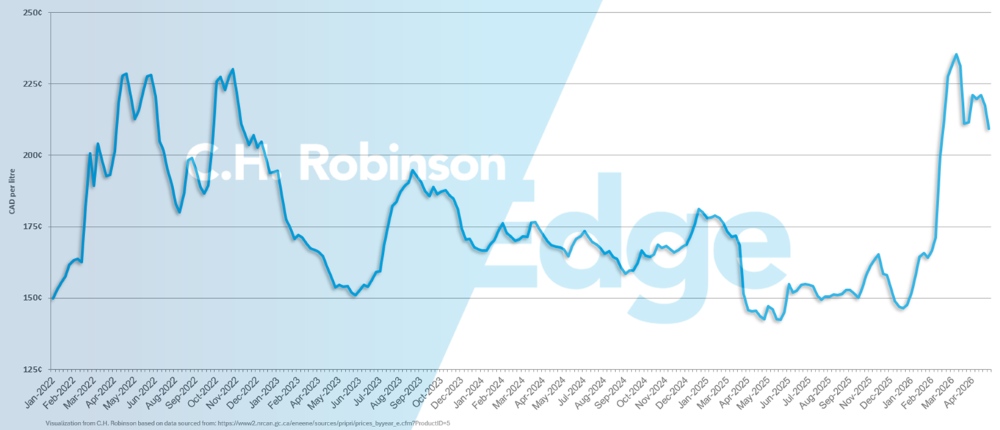
Le prix moyen national du diesel au Canada, indiqué ici en cents canadiens par litre, a légèrement diminué ces dernières semaines, mais reste élevé.
Prix moyen du gallon de diesel au Canada
 Des analyses exploitables sur le transport de marchandises