 Download slides
Ocean planning shifts from capacity to timing
Published: Thursday, May 07, 2026 | 09:00 am CDT
On this page
Why available capacity may not translate into preferred sailings
Ocean freight planning is increasingly defined by how reliably a preferred departure aligns with shipment timing.
Service adjustments by the carrier alliances, blank sailings, congestion at southeast Asia transshipment hubs, and vessel displacement in the Middle East are affecting both east-west and north-south lanes.
Earlier in the year, disruption was driven largely by rerouting around the Red Sea, which lengthened transit times and altered vessel rotations. In May, those adjustments are showing up more clearly. Booking windows, preferred departures, and downstream delivery plans may not align as consistently as they did earlier.
Service changes reduce Trans-Atlantic flexibility
The Trans-Atlantic market illustrates how departure timing variability is developing. Recent service changes between the United States East Coast (USEC) and north Europe are continuing to influence sailing availability in May. Bookings from ports such as Charleston and Savannah require extended lead time to secure preferred departures. Rather than limits on whether cargo can move, the more immediate effect is reduced flexibility.
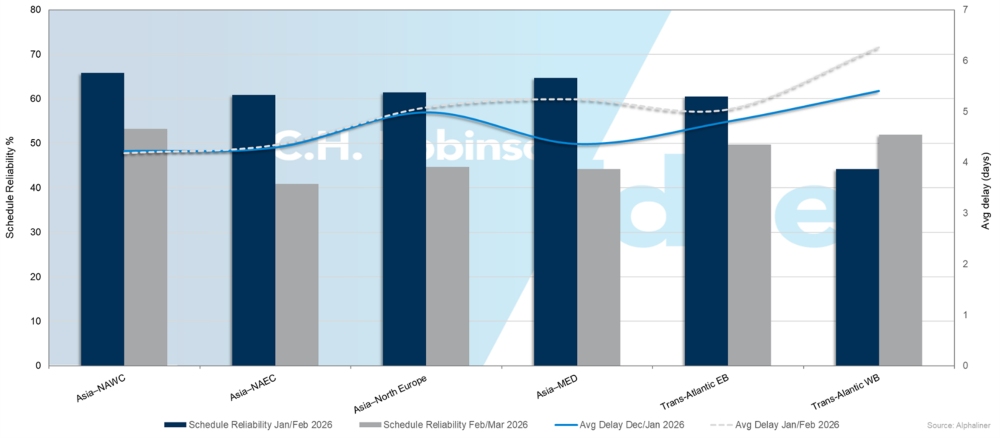
Recent schedule reliability indicators emphasize this shift, with Trans-Atlantic reliability declining by more than 11 percentage points month-over-month (m/m) in both directions and westbound reliability falling into the mid-40% range on some rotations.
Across major east–west lanes, schedule reliability declined m/m while delays remained elevated, reinforcing that sailing timing is less predictable even where space remains available.
Schedule reliability and average delay trends across major east–west trades
Asia transshipment hubs absorb more pressure
Across Asia–North America services, a similar departure-timing pattern is developing for a different reason. Softer demand across parts of north Asia is shifting vessel capacity toward southeast Asia routings, where many origins rely on transshipment through hubs such as Manila and Singapore. Congestion at these gateways is affecting feeder connections and onward vessel sequencing, which in turn is influencing whether preferred departures can be secured even where export containers are generally sufficient.
Reliability trends across Trans-Pacific eastbound (TPEB) services remain mixed m/m, while delays continue to track higher across the region. Together, these signals suggest timing variability is emerging at the rotation level rather than reflecting a corridor-wide capacity constraint.
Reliability across Asia‒Europe services softened modestly m/m, reflecting the continued influence of congestion at major transshipment hubs on downstream arrivals across connected rotations.
Middle East disruption continues reshaping rotations
The military conflict in the Middle East continues to affect vessel rotations well beyond Gulf-linked services, with knock-on effects visible across adjacent trade lanes. The Strait of Hormuz remains closed to container shipping, with approximately 100 to 120 vessels representing roughly 300,000 20-foot equivalent units (TEUs) effectively sidelined inside the Persian Gulf.
Suez Canal routings have not resumed at scale across most container networks, and ships continue to be diverted around Africa’s Cape of Good Hope. Rather than appearing as a single-lane capacity constraint, these conditions are lengthening vessel cycles, sustaining emergency bunker surcharges, and contributing to schedule adjustments as carriers rebalance rotations across adjacent trade lanes. The practical effect for May is less predictable sailing timing across affected services as extended vessel cycles continue to shift rotation schedules.
Indian subcontinent services are also experiencing spillover from these network adjustments. India gateways are absorbing some cargo previously routed through Gulf ports, increasing congestion and reducing schedule consistency on selected services. Space remains generally available across Indian subcontinent lanes, but schedule consistency continues to vary by rotation.
Regional stability still comes with localized timing risk
Across South America, conditions remain comparatively stable relative to Asia- and Europe-linked lanes. However, transshipment-dependent services continue to see some variability in arrival timing where hub congestion persists.
Oceania services are seeing incremental schedule adjustments as carriers introduce additional rotations from the USEC, which may create localized variability during network transitions even as overall reliability trends on the lane improve.
Softer import volumes in parts of North America are reducing the number of empty containers returning to some inland rail ramps, tightening equipment availability for export cargo. While these imbalances appear primarily import-driven rather than directly linked to Middle East vessel displacement, they remain an additional factor shaping export planning windows.
Overall, these developments point to a more timing-sensitive ocean market in May. The key planning issue is not whether container capacity exists in aggregate, but whether preferred departures remain accessible within required shipment windows. Routing structure, transshipment exposure, and sailing availability are becoming more important to execution than space availability alone.
For shippers, the planning question is no longer simply whether ocean capacity will tighten, but how reliably preferred departures can be secured from week to week across major global trade lanes.
Planning ahead
- Expect departure timing to remain less consistent than capacity indicators suggest. Blank sailings, service adjustments, and extended vessel rotation cycles continue to affect sailing availability across several east–west lanes, even where overall space remains available.
- Monitor transshipment exposure on southeast Asia routings. Continued reliance on hubs such as Manila and Singapore means downstream connection timing may remain sensitive to localized congestion and vessel bunching.
- Be flexible on Trans-Atlantic services. Recent service-string adjustments between the USEC and north Europe have reduced sailing options on some rotations and may continue to influence preferred departure timing near term.
- Plan for longer vessel rotation cycles tied to Middle East disruption. Cape of Good Hope routing and sidelined Gulf capacity are continuing to extend vessel rotation cycles and sustain fuel surcharges across affected lanes.
- Account for inland equipment variability at U.S. export origins. Softer import container flows through some rail ramps are reducing empty container availability in select inland markets and may affect export readiness windows where repositioning options remain limited.
Notable shifts this month
Trans-Atlantic booking windows remain extended
Booking lead times remain extended on selected USEC rotations following April alliance service adjustments between north Europe and North America. Departures from Charleston and Savannah are among the most affected, with vessels reported full into mid-May and roughly four weeks’ advance booking needed to secure preferred sailings.
TPEB blank sailings continue
Targeted blank sailings remain in place across selected Asia—North America lanes following the early-May Labor Day holiday period in parts of Asia. These adjustments will continue to influence departure sequencing in May even where equipment availability remains stable, making sailing timing the primary planning consideration across affected services.
Panama terminal changes add routing uncertainty
Operational transitions at Balboa and Cristóbal terminals are altering routing patterns through the Panama Canal region. COSCO has suspended Balboa calls and redirected empty returns to Atlantic-side terminals, while interim operations are being supported by APM Terminals and Terminal Investment Limited. Canal-linked transshipment timing may vary during the transition period, particularly for cargo moving between Pacific and Atlantic services via Panama connections.
Colombia gateway coverage is shifting
Service coverage into Colombia continues to evolve as Maersk moved the North Atlantic Express and Turbo Feeder services from Turbo to Puerto Antioquia. Separately, Buenaventura is no longer included on Hapag-Lloyd’s direct MSW rotation and is now served via transshipment routing, changing direct-call assumptions for cargo moving between North America and Colombia.
Surcharge programs across Indian subcontinent services continue to adjust as networks rebalance
Routing patterns across Indian subcontinent services continue adjusting as cargo previously moving through Gulf gateways shifts toward India gateways. This shift is increasing congestion exposure at selected India ports and contributing to variability in sailing timing on some rotations. Space remains generally available across major Indian subcontinent–North America lanes, but departure timing may vary by service as networks continue to rebalance.
Key takeaways
- Evaluate booking lead times by trade lane. Trans-Atlantic services, selected TPEB sailings, and some Indian subcontinent rotations may require different advance booking windows even when overall space conditions remain stable.
- Monitor whether preferred sailings align with delivery requirements. Blank sailings, service-string adjustments, and transshipment exposure are continuing to influence departure timing more than shipment feasibility.
- Consider alternate routing options where direct-call structures have changed. Colombia gateway shifts and Panama terminal transitions may affect transit timing, transshipment exposure, and equipment positioning assumptions.
- Build flexibility into cargo moving through congestion-sensitive gateways. Itapoá, Paranaguá, Manila, and Singapore remain key watchpoints for schedule consistency.
- Review routing-specific surcharge exposure on Gulf-, Indian subcontinent-, and Cape-routed services. Fuel- and disruption-related charges continue to vary by carrier, lane, and routing as networks adjust to extended vessel rotations and Middle East displacement effects.
 Actionable freight insights