Challenge
A leading tech manufacturer sought to redesign a solution centered on total customer experience that mitigated volatility and decreased delivery times.
Solution
C.H. Robinson Managed Solutions™ executed a complete redesign, transitioning the company to a hub-and-spoke model powered by an AI-enabled transportation management system (TMS).
Result
The manufacturer achieved 95%+ delivery predictability and nearly doubled its two-day delivery reach while reducing transportation costs and ecological footprint.
-

-

-

-

-
Copia negli appunti
With roots in early Silicon Valley innovation and nearly a century of progress behind it, one leading tech company has become a trusted force in personal computing, printing, and digital workplace solutions. The company’s hardware helps power productivity for businesses, institutions, and consumers around the world—serving as a critical connection point between people and the digital tools they rely on every day.
With a presence in nearly every country and a product portfolio that touches millions of lives daily, the company needs a supply chain that’s more than just a cost center—they need a competitive advantage. To continue leading in a world defined by instant delivery and constant volatility, the manufacturer recognized that its supply chain needed to be as innovative as the products they ship.
Rebuilding a network for total customer experience
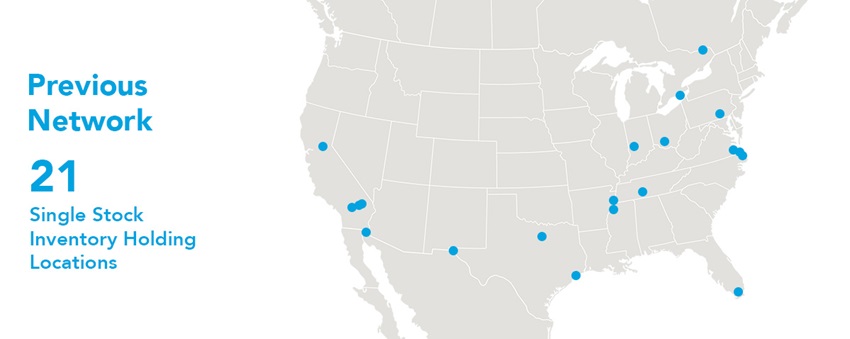
For decades, the company’s North American logistics network was a titan of scale. Through organic and inorganic growth, their network became decentralized with more than 20 single-stock locations. For example, single stocked ink on the East Coast was shipping across the country, impacting their agility. While this model provided broad geographic coverage, it lacked the velocity required for the modern customer.
It was a system built to react, not to anticipate. When a node was disrupted, the entire network felt the tremor. Lead times were inconsistent, customer experiences were fragmented, and the carbon footprint was growing as inefficient routes led to higher CO2 emissions.
Designing for the future with C.H. Robinson
The manufacturer established a vision that was as bold as it was necessary: to evolve the supply chain from a traditional cost center into a smart business strategy. This required a complete ground-up redesign that ignored the constraints of the past to focus on long-term value.
Working with C.H. Robinson Managed Solutions™, the company’s supply chain team set out to create an AI-augmented supply chain that could turn their logistics strategy into an unrivaled competitive advantage.
Engineering the hub-and-spoke model
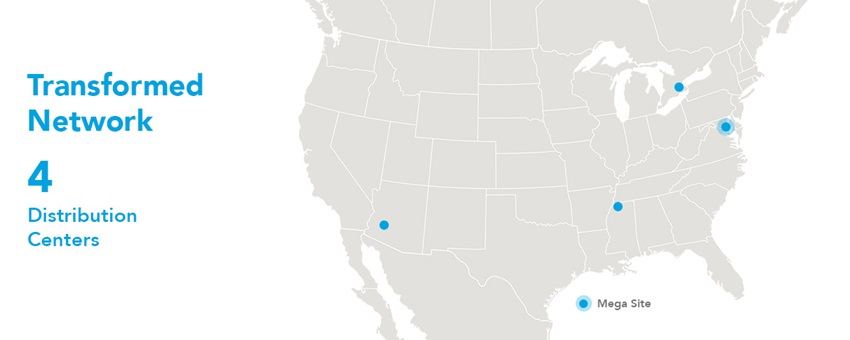
The first step of the three-year project was a major consolidation of physical infrastructure. The team shifted away from the 20+-node, decentralized model to a highly efficient hub-and-spoke architecture anchored by four distribution centers (DCs)—three strategically placed across the United States and one in Canada.
This wasn’t just about reducing the number of buildings. It was about creating centers of excellence. By implementing multi-stock fulfillment for over 80% of SKUs, the company significantly improved its resilience. No longer was the availability of a product dependent on a single, vulnerable node. If one location faced a disruption, the network’s inherent flexibility allowed other hubs to absorb the demand without a lapse in service.
This physical redesign was complemented by intelligent inventory placement. By analyzing demand patterns, products were positioned closer to the end customer. The impact on speed was instantaneous, but the impact on sustainability was equally profound. Shorter transit times meant fewer miles driven and a significantly reduced carbon footprint.
Beyond traditional TMS with Lean AI orchestration
While the consolidated DCs provided the physical infrastructure for the new strategy, the AI-enabled transportation management system (TMS) from C.H. Robinson was the foundation for their entire North American network.
In a traditional model, a TMS is a record-keeping tool. In this new world, the TMS is a sensing agent. It uses AI-driven transportation planning to perform continuous re-optimization. The system doesn't just plan a route and walk away; it watches the world in real-time. It looks at customer demand and need by dates, then analyzes real-time DC inventory, transportation capacity, and potential risk. Using that information, the system then generates level loading for each week to meet total customer experience metrics for consistent throughput—all through AI.
Resilience in the face of rollout
Transforming a logistics network of this scale while maintaining global operations required a rollout with absolute execution resilience. By leveraging AI to automate exception detection and shipment reconciliation, C.H. Robinson was able to stabilize new lanes and providers faster than ever before.
Documentation, which historically acted as a bottleneck in logistics transitions, was handled through AI-augmented workflows. This supported a smooth ramp-up, ensuring that as volume shifted from the old nodes to the consolidated DCs, the customer experience remained seamless.
The results: A new standard of logistics excellence
In under three years, the initial vision had become a reality. The numbers tell a story of a network that is not just faster, but fundamentally more intelligent:
- Hyper-local velocity: Average inventory positioning moved from 2.8 days away from the customer to just 1.1 days.
- The two-day standard: Two-day delivery coverage skyrocketed from 43% to 88%.
- Reliability redefined: On-time delivery lead times were slashed from over eight days to fewer than five.
- Total predictability: The network now operates with a consistency rating above 95%.
Beyond the speed and service metrics, the financial and environmental benefits were equally stark. Transportation and warehouse costs were lowered through optimized routing and consolidated nodes. The “carbon-aware” routing logic embedded in the TMS ensured the evolution toward competitive differentiation was also a step forward for the planet.
Scalability by design: The next chapter
The most significant outcome of this transformation is perhaps the most invisible: scalability. Because AI absorbs much of the day-to-day complexity of execution, the company can now scale its volume, add new nodes, or pivot fulfillment paths without a linear increase in headcount.
The next chapter is one of continued AI augmentation, shortening the time between insight and action. Their approach has not only brought products closer to their customers but has also created a shield against supply chain volatility.
Learn more about C.H. Robinson Managed Solutions by connecting with an expert today.