


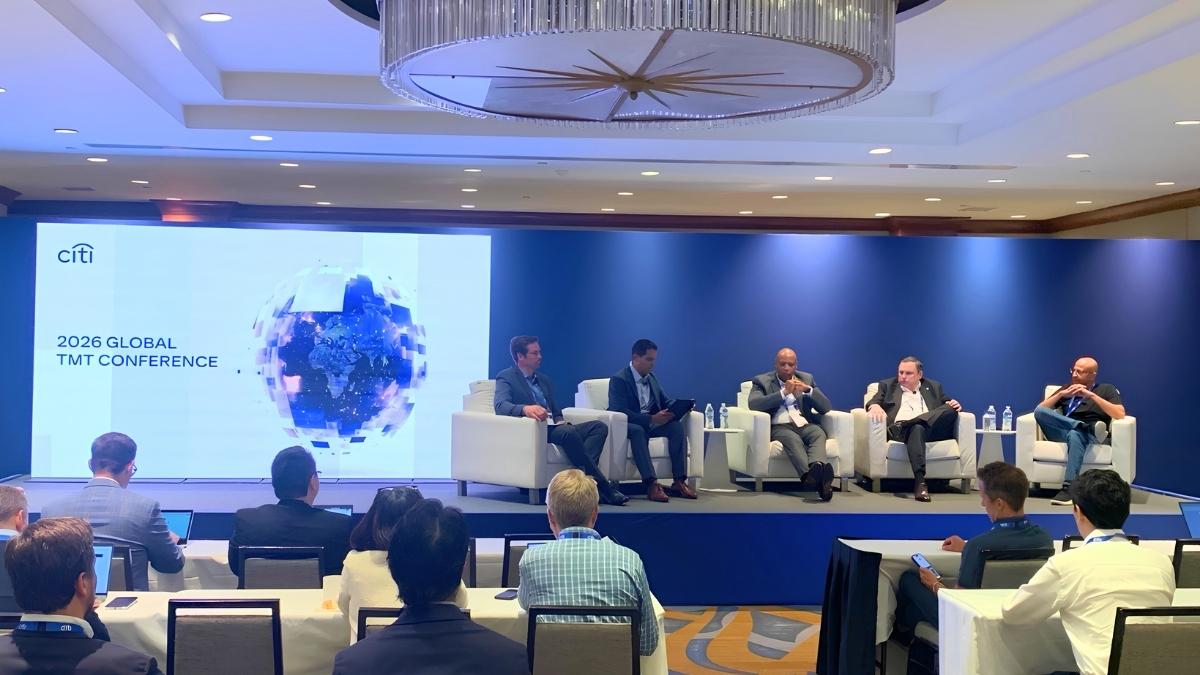
Recent conversations with investors covered shifting market dynamics, accelerating AI adoption, evolving legal expectations, and the ongoing focus on sustainable profitability and growth at C.H. Robinson.
While headlines often focus on freight rates, technology trends, or legal developments, investors are increasingly focused on a broader question: which companies are best positioned to perform and create value as market conditions evolve?
Transformation shows up in the results
One of the frequently asked questions was whether the company can sustain the momentum of its ongoing transformation that has delivered measurable results. For C.H. Robinson, the answer is reflected in its consistent track record of operational and financial performance.
"Looking back, it's been a little over three years [since our transformation began]. We've had 13 quarters in a row of truckload outgrowth and 10 consecutive quarters of beating EPS consensus. That's not going to stop. We're going to continue. Why? Because our Lean operating model has unleashed our technology, unleashed our people, and allows this company to be a disruptor and move at a pace the industry is not used to,” said Dave Bozeman, President and Chief Executive Officer at C.H. Robinson.
And the results don’t stop there. Since late 2022, productivity in C.H. Robinson’s North American Surface Transportation and Global Forwarding businesses has improved by more than 60%. Over that time, the company has combined Lean operating principles, proprietary technology, and AI-enabled automation to build a more scalable operating model.
"If you were to ask somebody two years ago, could a broker have flat AGP (adjusted gross profit) per load when spot rates were up over 30% in a market that was down 4.5%, they would've told you it was physically impossible. We demonstrated that in Q2," said Damon Lee, Chief Financial Officer of C.H. Robinson.
Making these results even more impressive is the fact that this was accomplished while the company increased its year-over-year contractual volume, which was under the most pressure at the AGP per load level.
The company attributes those results to the combination of proprietary price and cost-discovery capabilities, Lean operating disciplines, and revenue management practices. These capabilities allow teams to identify changes in profitability sooner and implement targeted countermeasures faster than in prior freight cycles.
Market-share gains are creating separation
Another frequently asked question was about the drivers of the company’s consistent market share gains. In its North American Surface Transportation division, C.H. Robinson has gained market share for 13 consecutive quarters. Management attributes that performance to continued growth in targeted verticals and small and medium-sized business customer segments, deeper customer engagement, expanded cross-selling, and technology that provides faster quotes and enables employees to focus more on strategic solutions for customers.At the same time, freight-market dynamics are also changing customer behavior. After nearly four years of soft market conditions, roughly 20% broker attrition, rising operating costs, and increased legal scrutiny across the industry, some shippers are reevaluating the number of providers they use and consolidating freight with a smaller group of brokers.
That shift is favoring providers with larger networks and established operating models. C.H. Robinson serves approximately 75,000 customers, has more than 450,000 contract carriers on its global platform, and helps manage approximately 37 million shipments annually. The company’s scale, network quality, technology, and disciplined execution continue to differentiate it in an increasingly selective market.
Lean AI is delivering measurable results
Technology was another consistent topic throughout investor discussions, particularly around how C.H. Robinson is differentiating themselves as AI tools become more broadly available.
The company’s view is that AI itself is not the moat. The advantage comes from combining custom-built AI agents with proprietary data, engineered context, world-class logistics expertise, and a Lean operating model grounded in continuous improvement. Together, these capabilities have created a more scalable operating model, widened the company’s moats and enabled disciplined AI spending.
“There is no hobby spend on AI at C.H. Robinson,” said Lee. “Every dollar we spend on tokens, every dollar we spend on engineering capacity has a readymade high-probability ROI assigned to it. And on an annualized basis, we spend less than $1.2 million on (AI) tokens.”
Today, Lean AI supports work throughout the quote-to-cash lifecycle, helping automate repeatable tasks, improve response times, and allow employees to focus on customer relationships, supply-chain solutions, and complex operational challenges.
Those capabilities are supported by approximately 100 trillion proprietary data points and more than 450 engineers and data scientists. As freight demand improves, the company expects those investments to continue supporting stronger operating leverage, faster decision-making, and additional productivity gains.
Legal and insurance discussions require context
Investors continue to monitor how legal developments may affect both risk exposure and insurance costs across the transportation industry. Supported by years of continuous improvement in carrier-vetting and monitoring capabilities, including proprietary process enhancements and partnerships with firms such as Highway and GenLogs. C.H. Robinson has long operated a safe network at scale. The company believes this foundation positions it to better navigate the evolving legal environment while helping shippers move freight safely and responsibly at scale.
Management emphasized that legal developments should be viewed within the context of the company's scale and long operating history. C.H. Robinson helps manage approximately 37 million shipments annually. Its legal docket consists of cases measured in the tens across multiple years, during which it has facilitated hundreds of millions of loads.
"98% of our cases get dismissed or settled. We don't think that trend is going to be disrupted post-Montgomery and post-Lipe. We still believe the vast majority of cases will be settled,” said Lee, who noted that historically, the vast majority of settlements have been below C.H. Robinson’s deductible amount.
Investors also focused on the implications of potential insurance costs.
"We are going through insurance renewal right now. So once these insurance companies essentially provide their verdict on C.H. Robinson for 2027, I think that will give you great insight on what they view as the risk profile of our docket and what they view as the risk profile of Robinson," Lee said.
"Some of the more bearish sentiment on the street that insurance costs will go up hundreds of percent - we do not view that will be the case for C.H. Robinson. We think inflation will be a very manageable number," Lee said.
Insurance inflation has affected transportation for years. In 2025, annual insurance and claims costs totaled less than 0.5% of total revenues, while auto liability insurance represented less than 0.25% of total revenues. The company expects insurance inflation to remain manageable within the context of its operating model and believes broader industry cost increases ultimately become part of freight-rate economics.
Clear standards matter
Accountability across a national freight network was also a key part of discussions. Freight moves across state lines every day, yet carrier-selection expectations can vary depending on jurisdiction and legal interpretation. C.H. Robinson supports and has been advocating for clearer, more consistent standards that are objective, transparent, and applied uniformly across the transportation industry.
"We are driving a legislative and rulesmaking vector as well. We are working with FMCSA to get a standard through the Department of Transportation and have a lot of our transportation industry peers that are following with us on responsible freight. I'll be in DC next week, working on a legislative solution to this as well, with certain bills going through that we think will apply the right accountability and responsibility. So we are going to continue to lead the industry on that," said Bozeman.
That work continues through broader industry discussions and support for a clear federal carrier-selection standard. Through those efforts, C.H. Robinson is helping shape conversations around accountability and responsible freight movement across the industry.
Looking ahead
Across each topic, from productivity and market share to AI, risk management, and industry accountability, a common theme emerged: execution.
Investors are increasingly focused not only on how freight markets are changing, but on which companies are best positioned to perform through those changes. Questions around operating leverage, technology, market share gains, and risk management ultimately come back to the same issue: the ability to create long-term value in a dynamic industry.
As freight markets evolve, C.H. Robinson’s capabilities position it to continue serving customers at scale, creating operating leverage, delivering profitable growth, and continuing to lead the industry in advocating for clearer safety standards, increased accountability and stronger enforcement to help improve road safety in America.
 Información exclusiva