 Download slides
LTL costs climb as capacity continues to tighten
Published: Thursday, August 06, 2026 | 09:00 AM CDT
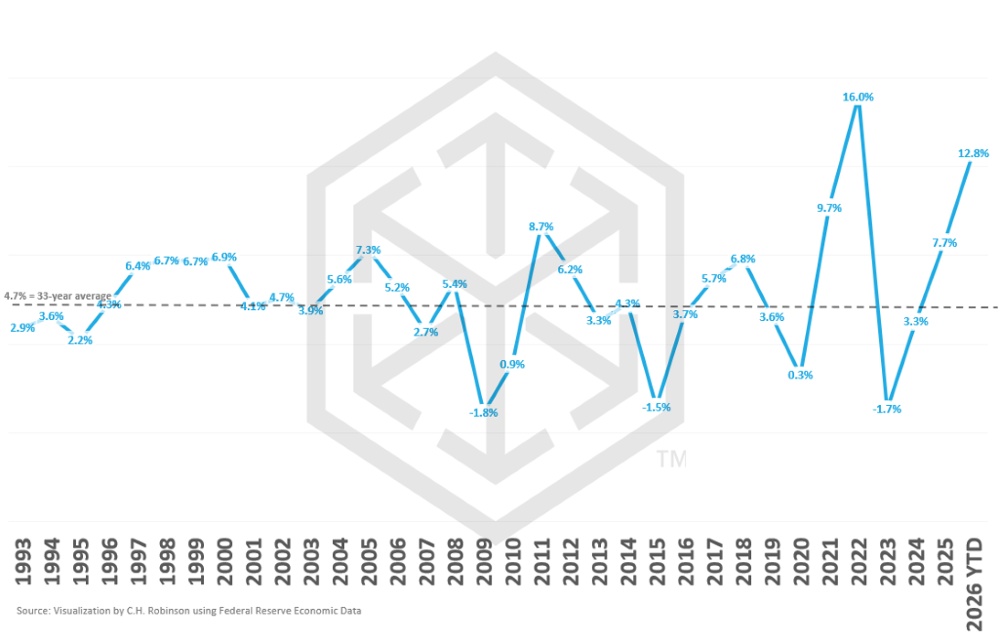
The Less-Than-Truckload Producer Price Index (PPI), which measures total LTL prices paid by shippers including fuel, rose 19.6% year over year (y/y) during the second quarter of 2026. While this is not the highest quarterly increase on record (that distinction belongs to the second quarter of 2022, with a reading of 22.1%), it is the second highest.
The common thread between the two periods is a sharp increase in diesel costs. In the second quarter of 2022, diesel cost per mile increased more than 70% y/y. More recently, diesel cost per mile increased more than 50% y/y during the second quarter of 2026.
Year-over-year change in LTL Producer Price Index
Fuel has been the largest contributor to the recent rise in LTL PPI, but not the only factor. The broader freight market is in a very different position today than it was in 2022. Four years ago, truckload freight capacity was expanding and market conditions were gradually softening.
Today, truckload capacity is contracting. As carriers leave the market, upward price pressure is building across both truckload and LTL modes. Base linehaul rates are increasing alongside fuel surcharges, creating a much different pricing environment than previous fuel-driven spikes.
What makes the current market particularly noteworthy is the speed of the change. The LTL PPI accelerated from a 5.9% y/y increase in the first quarter to 19.6% y/y in the second quarter, a jump of 13.7 percentage points.
This represents the largest quarter-to-quarter increase in the history of the index and is nearly double the next-largest increase ever recorded. The combination of rising fuel costs and tightening capacity has created one of the most significant pricing shifts the LTL market has experienced.
What can shippers do to mitigate increasing LTL costs?
Optimise your freight
As both linehaul rates and fuel surcharges increase, shippers should evaluate opportunities to consolidate freight. Combining multiple deliveries or increasing delivery density can improve transportation efficiency and reduce total cost.
Diversify your carriers
As carriers increasingly focus on optimising their own network, pricing can vary significantly depending on how well freight aligns with their footprint. For example, you’ll likely pay more if your freight creates extra deadhead miles for the carrier. Matching freight to the most suitable providers can help to identify savings opportunities.
Improve delivery accuracy
Inaccurate delivery details often lead to reclassifications, inspection charges and other accessorial fees. Ensuring accurate dimensions, weights, classifications and delivery characteristics up front can help to avoid unnecessary charges and improve consistency of costs.
 Actionable freight insights