The freight market has tested this industry for the better part of four years. Demand has stayed uneven, capacity has shifted, and costs have moved quickly. Across transportation and logistics, companies have had to prove whether their strategy can create value in any environment, not just when the cycle is favorable.
At C.H. Robinson, we’ve been focused on building a company that can deliver stronger, more durable performance through the cycle. That has meant deliberate changes to our operating model, cost structure, technology, and day-to-day execution.
Our recent financial results show that work is continuing to take hold. In a freight market that remains far from its peak, we’ve continued to gain share, expanded margins, improved productivity, and delivered strong profitability, progress driven by disciplined execution, better decision-making, and our Lean AI strategy.
That was the message President and CEO Dave Bozeman and I shared recently at Deutsche Bank’s Industrials Conference. We discussed how C.H. Robinson’s transformation is showing up across the business: in stronger performance, better execution, improved productivity, and better improved outcomes for customers and carriers.
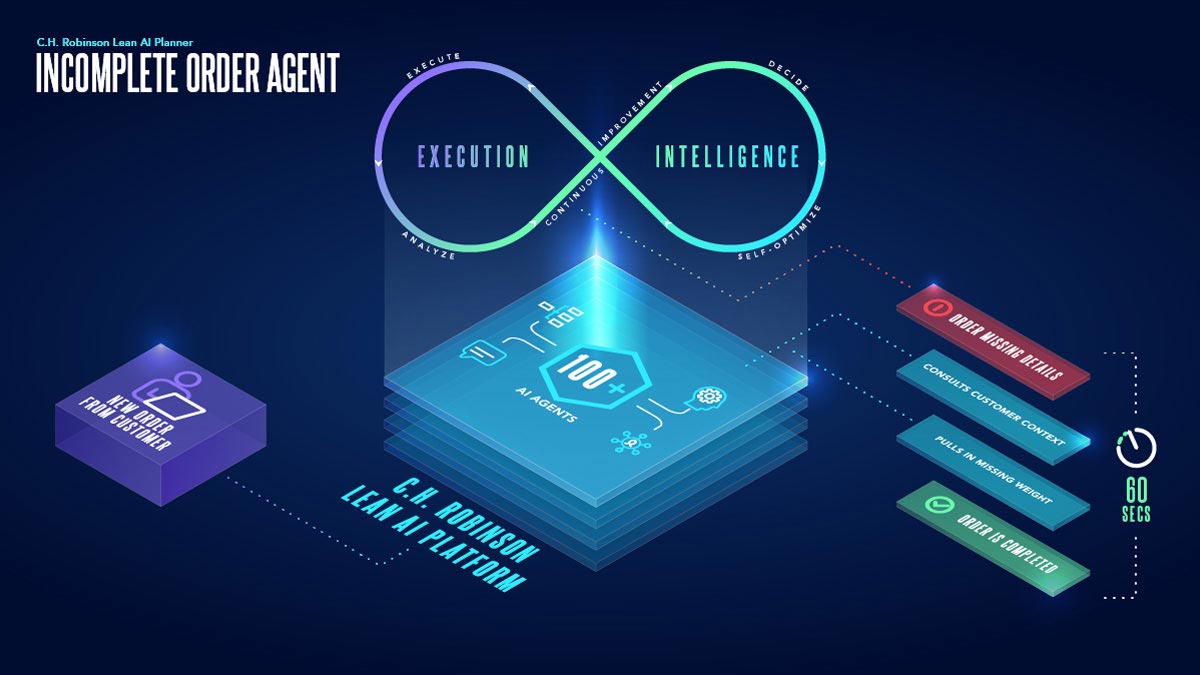
For us, Lean AI is not a pilot program or a technology layer sitting off to the side. It is embedded directly into workflows such as pricing, execution, procurement, quoting, and settlement. Tasks that once required people to sort through emails, gather data, build quotes, process orders, schedule appointments, or chase shipment updates are increasingly handled inside AI-enabled workflows.
The impact is practical and meaningful. Our people can move faster, make better decisions, and spend more time with customers and carriers, managing exceptions, solving complex supply chain problems, and applying their judgment where it matters most.
Technology alone is not the differentiator. The differentiator is our operating model, proprietary data, scale, and people working together.
That combination lowers our cost to serve, creates leverage, and helps us deliver stronger outcomes for customers, carriers, our people, and the business over time.
We are seeing that show up today. Our people are operating with greater discipline, supported by technology that helps them respond faster, price more intelligently, and manage complexity with better data. The result is better service for customers and more time for our people to focus on the work that matters most: navigating disruptions, finding carrier solutions, improving shipment plans, and keeping commerce moving.
Lean AI is not about replacing expertise; it is about making expertise more valuable. As routine work moves into the system, our people can build new skills, work more closely with customers, contribute to continuous improvement, and take on more strategic roles in a changing industry.
Importantly, we have been investing in these improvements and delivering results before a broad freight demand recovery has fully materialized.
Much of today’s market tightening is supply-driven, not demand-driven. That distinction is important because our performance is not dependent on a cyclical rebound. We are controlling what we can control: execution, productivity, customer value, disciplined decision-making, and the quality of the work we do every day.
That gives us confidence as we look ahead. When demand improves, the operating leverage in this model should become even more meaningful. We’ve fundamentally changed the relationship between volume growth and headcount growth, allowing more incremental volume to move through the system while our people remain focused on service, problem-solving, and customer growth.
As CFO, I look at our results as proof points of success. They show a business creating more operating leverage while expanding capacity to serve, improving execution, and giving our people more opportunity to grow into higher-value work.
That is the broader story. We are not simply managing through a difficult freight market. We are using this environment to sharpen how we operate, strengthen the value we deliver, and create a clearer path to profitable growth.
Cycles will continue to move and markets will change. The companies that win over time are the ones that build durable advantages before the cycle turns. That is what we are doing at C.H. Robinson: delivering strong results now while building the discipline, technology, and people-powered model to make the next phase of growth even more compelling.
See how we turn Lean AI into action