For decades, logistics has operated on a simple assumption: scaling performance required scaling people. TMS platforms, 3PLs, and 4PLs improved freight execution, but all still rely on staff to plan, adapt when conditions change, and assess results. Great operators deliver great results, but outcomes still depend on the quality, availability, and continuity of the talent available to run the system.
We see things differently at C.H. Robinson Managed Solutions. When a tech platform can plan shipments, execute on them, resolve exceptions, and improve continuously without human intervention, performance no longer scales through labor. It scales through operational intelligence.
What makes this possible is agentic AI and our proprietary new Lean AI Engineer that joined the Lean AI Planner we introduced last year. Together, they oversee a fleet of AI agents that can perceive, decide, act, and improve while orchestrating a global supply chain.
By removing the talent constraint, it reshapes legacy models and raises what customers can expect from logistics itself.
Connecting intelligence and orchestration for the first time
Our proprietary, end-to-end system uses AI to manage shipments across modes and regions, while improving over time. At its center are two capabilities working together continuously in a closed loop.
The Lean AI Planner is the autonomous orchestration layer. Starting at the order level, it coordinates shipment planning, routing, tendering, freight tracking, exception management, delivery, document handling, and settlement across modes and regions. Over 92% of 4PL shipments are orchestrated autonomously, including complex scenarios such as order changes and routing disruptions. This is not a lab result. It’s a metric based on live freight today.
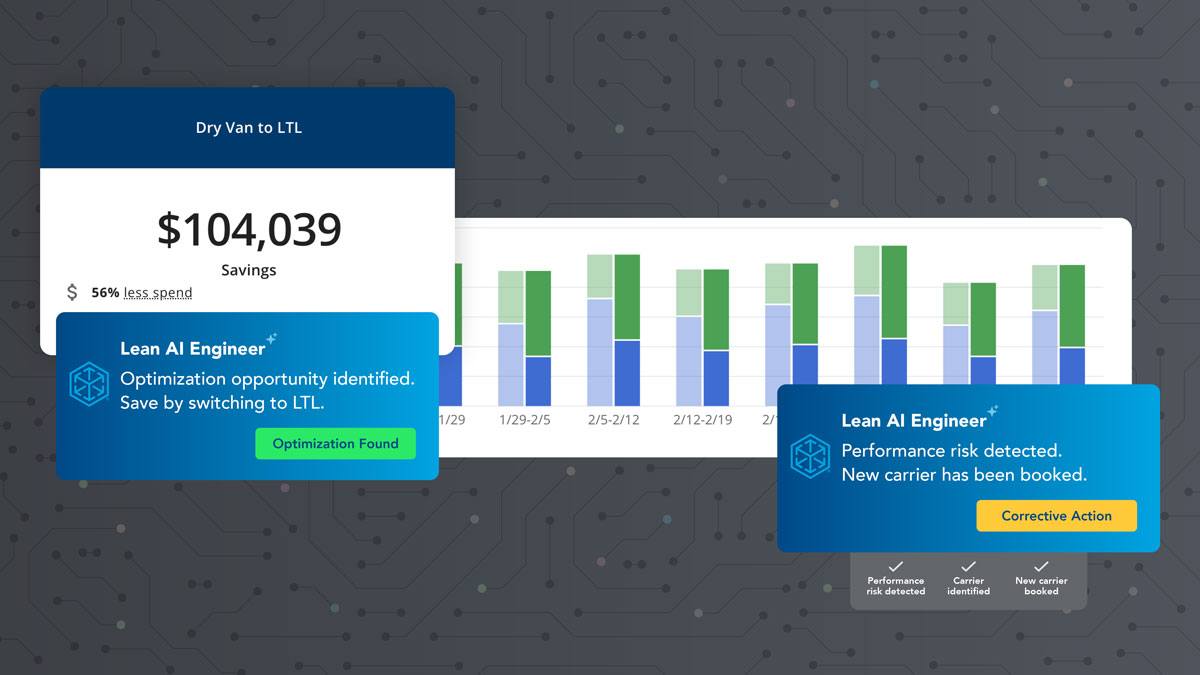
The Lean AI Engineer is the continuous learning and improvement layer. It analyzes outcomes, detects emerging risk, and feeds intelligence back.
Lean AI Planner orchestrates. Lean AI Engineer studies and improves. They form a self-healing loop where the system gets smarter through the operation itself. The cycle repeats on every order, every shipment, every region. A supply chain network doesn’t simply recover from disruption. It becomes better at preventing it.
Why this is architecturally different
One of the most important distinctions between our AI system and others is the difference between observation and orchestration.
Platforms built on visibility data accumulate signal from watching freight move. That intelligence can tell you what’s happening in the downstream stages of a supply chain. It’s valuable but remains fundamentally observational.
Observation is not orchestration, and it’s not useful for managing a supply chain end to end because the system sees only part of the supply chain, therefore its intelligence is partial.
It’s also reactive rather than self-healing. When a platform’s architecture is built around waiting for a signal, something has already gone wrong, it detects the condition and routes work to be done. That may help with a decision in the moment, but it doesn’t improve how the overall supply chain functions.
The Lean AI Engineer operates continuously inside live freight execution, identifying root causes and feeding that intelligence back, so the next cycle performs better than the last.
Infinite talent. Not infinite labor.
Some may argue that the benefit of AI is infinite labor, now that AI can replicate work that previously only humans could do. That’s missing the point and that’s not what shippers have ever been after. They need infinite talent: the judgment to navigate disruption, the eye for detecting cost leakage, and the foresight to prevent problems before they spread. That expertise doesn’t scale by itself.
The Lean AI Planner and Engineer encode the expertise of C.H. Robinson’s world-class logisticians directly into the tech: the judgment of your best planner, the pattern recognition of your most experienced supply chain engineer, and the institutional knowledge built through decades of running freight across thousands of networks.
The great talent doesn’t go away. It’s embedded in the AI. It’s put to use 24/7. It doesn’t leave when someone goes on vacation or changes roles.
What changes for the customer
In traditional logistics service models, supply chain leaders spend enormous energy managing disruption, chasing updates, and coordinating recovery. In an autonomous model, the AI not only absorbs more of that burden, it creates measurable operational advantages, including:
- time saved from fewer manual touches across the steps in each shipment
- more consistent service across regions and modes
- fewer operational surprises
- faster exception resolution when conditions change
- more proactive decisions before service degrades
- continuous improvement in network performance over time
- a supply chain that becomes more reliable and more intelligent with every shipment
That’s not lower-cost labor. It’s premium service built on infinite talent.
As Jeff Davidson, head of Microsoft’s Global Supply Chain and Customer Operations, puts it: “C.H. Robinson Lean AI is bringing the convergence of people, continuous improvement, and technology. We’re able to take that intelligence, that level of partnership, that level of co-innovation that we deploy and we basically create a flywheel of continuous nonstop transformation for ourselves.”
The old logistics model was built on scaling labor. The next model is built on scaling talent.
And it is running today.
See what's possible