 Download slides
Ocean capacity is available, but execution risk is rising
Published: Thursday, September 03, 2026 | 09:00 AM CDT
On this page
Ocean capacity conditions leave less room for recovery
September is not shaping up as a conventional late-summer peak for U.S. imports. Data suggests that this year’s peak arrived earlier and may taper more quickly than usual. That means capacity should be available, but operating conditions can limit a shipper’s options if a planned move is missed.
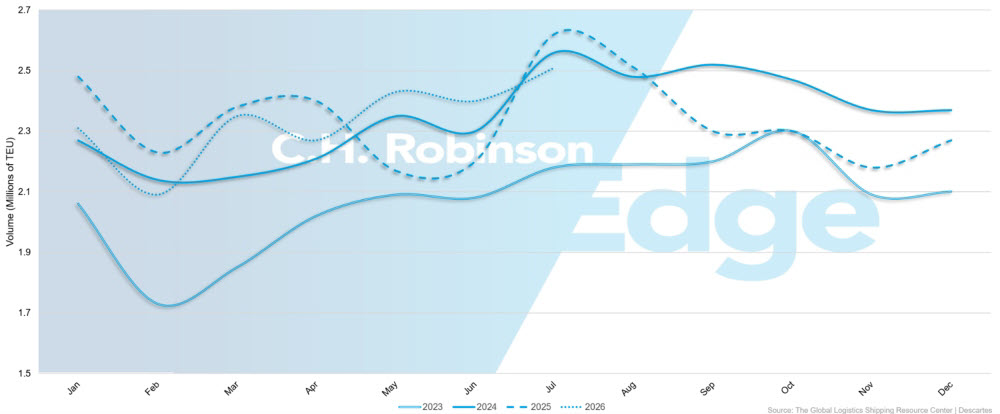
Descartes recorded 2.51 million U.S. import TEUs in July, up 4.5% from the month before but 4.3% below July 2025. China-origin imports increased 7.2% to 873,129 TEUs, their highest monthly level in a year. Longer transit delays at most major U.S. gateways were also reported, although conditions did not indicate broad port congestion.
Meanwhile, the National Retail Federation’s Global Port Tracker forecasts 2.16 million U.S. import TEUs in September, down from 2.22 million in August.
2023-2026 U.S. container import volumes
On the surface, the global fleet appears large enough to support current Asia-U.S. demand for September. Many European and Oceania trade lanes also remain balanced between supply and demand, although North Europe-North America is a notable exception.
The operating picture is less comfortable. A succession of typhoons has disrupted vessel schedules and created congestion at major Chinese ports. Panama Canal draft restrictions are limiting vessel utilisation on affected services. Blank sailings, carrier network changes and congestion at ports and inland terminals are further reducing the global ocean network’s ability to recover.
If a shipper’s planned vessel is delayed, skips the origin port or cannot accept the cargo, the next viable option may leave later, use another gateway or require a more complicated transshipment. Container availability, cargo weight and terminal access can narrow those choices further.
Asian port congestion is pushing up Trans-Pacific rates
The typhoons across China have created backlogs and caused vessel bunching at Shanghai, Ningbo and other major gateways. As of 25 August, Linerlytica estimated that approximately 4.3 million TEUs or 12.6% of global containership capacity, was tied up in port congestion.
The disruption has changed the near-term rate outlook. Trans-Pacific spot rates increased in late August as blank sailings, capacity reductions and port congestion tightened available space. In the week ending 20 August, rates from Shanghai to Los Angeles and New York both increased 9%, according to the Drewry World Container Index.
Trans-Pacific bookings are expected to increase in late September as shippers move cargo before China’s National Day holiday, 1-7 October. Cargo delayed by the recent storms will also compete for space as carriers continue working through the backlog.
For cargo that must leave before the holiday, a booking confirmation does not eliminate execution risk. Shippers should leave enough time to respond if a vessel is delayed, the origin port is omitted or cargo is moved to a later sailing.
Whether recent Trans-Pacific rate increases hold through September depends on how quickly vessel schedules recover and how aggressively ocean carriers reduce capacity as forecast U.S. import volumes ease.
Rate trends on Asia-Europe services have diverged from the Trans-Pacific. Spot rates to Rotterdam and Genoa declined in late August despite continuing congestion and operational disruption. Unlike the Trans-Pacific, those issues have not yet translated into higher Asia-Europe rates.
Carrier network changes are tightening Indian Subcontinent services
The Indian Subcontinent remains one of the tightest origin markets. Service withdrawals, port omissions, container shortages, transshipment congestion and tighter carrier allocations have reduced the number of workable booking options to North America and Europe.
Shippers should allow approximately four weeks for North America and at least three weeks for Europe. Some Europe services may require four to six weeks, particularly when main-vessel allocations are limited or containers must be repositioned from another location.
When preferred services are full, carriers may propose routings with additional transshipment stops. Shippers should compare the complete schedule carefully, because an extra connection can add significant transit time and increase the risk of another delay.
Premium services may provide faster access to space on certain lanes, but availability and pricing vary by origin, destination and sailing.
Manzanillo port issues continue landside
An entire service doesn’t have to be cancelled for port congestion to affect a delivery. Extended container dwell time and missed connections can disrupt the sequence of a service and delay containers from getting to the next origin. The result can be nominal space on a vessel but no available container at the shipper’s location—or a viable sailing the freight can’t reach before the terminal cutoff.
At the Port of Manzanillo, Mexico, current disruption is concentrated landside. Vessel waiting times remain relatively low, but road construction, lane reductions, congestion at port access points and terminal appointment delays are affecting truck movements.
Travel along the Manzanillo-Guadalajara corridor can increase from 3.5-4 hours under normal conditions to 6.5-8 hours during heavy congestion. Longer truck cycle times can delay container pickup, return of empties and delivery to the terminal.
For export cargo, a late truck appointment can lead to a missed receiving window and move the container to a later sailing even when the original vessel had available space.
For more on terminal access, drayage and inland conditions at Manzanillo and other gateways, see the Ports & Drayage section of this report.
Some service is returning to the Suez Canal
Several ocean carriers are restoring services through the Red Sea and Suez Canal, but the return remains highly selective. Maersk and Hapag-Lloyd have returned additional Gemini services to the route and MSC announced a partial restoration of several East-West services in late August.
Regional security conditions, including military actions around the Middle East and Strait of Hormuz, remain an important watchpoint as carriers evaluate whether additional Suez services can return safely and consistently.
This is an encouraging development, but it does not represent a networkwide return. The changes remain service-specific, subject to ongoing security reviews and reversible if regional conditions deteriorate.
A broader recovery would mean carriers using the Suez route consistently, publishing shorter transit times, accepting bookings on those services and adjusting surcharges and vessel deployments accordingly.
Expect routing to remain inconsistent in the near term. One ocean carrier may offer a shorter Suez Canal service while another continues diverting around Africa’s Cape of Good Hope. Shippers should verify the complete routing, connection points and published schedule rather than assume that a quoted transit time reflects a broader return to Suez.
Panama Canal restrictions are turning cargo weight into a capacity issue
The Panama Canal remains open, but with reduced draft allowances and fewer available transit slots in September.
The canal’s maximum authorised draft for Neopanamax vessels is scheduled to decline to 48 feet on 2 September. A further reduction to 47.5 feet, originally planned for 3 September, has been postponed until 1 October. The canal is also reducing available Neopanamax transit slots beginning in September, which could increase waiting times for vessels without secured bookings.
Ocean carriers may respond by reducing vessel utilisation, introducing surcharges or restricting heavy containers on specific services. Those decisions will vary by carrier, vessel and sailing. The canal has not imposed a general weight limit on individual containers.
Containers carrying heavy commodities—including machinery, industrial equipment, chemicals, liquids, timber, pulp and paper—may need to be lightened, split or moved on another service when lower draft limits apply. Shippers should confirm the allowable cargo weight before assuming that a container can move on the booked vessel.
U.S. East Coast rates from Asia may remain firmer partly because of canal restrictions, blank sailings and reduced capacity. The effect is not limited to Asia-U.S. imports. North American exports and other services that rely on the canal may also experience schedule changes or weight restrictions.
Before treating a cargo booking as secure, confirm:
- Whether the service uses the canal
- Any canal-related surcharge
- Cargo-weight acceptance by ocean carrier and service
- The effect of rerouting or splitting cargo on delivery timing and cost
- Available alternatives if the container is rejected or the vessel’s utilisation changes
Notable shifts this month
Trans-Atlantic conditions differ by origin
North Europe-North America lanes remain highly constrained as ocean carriers work through cargo rolled from earlier sailings. Some carriers are booked through mid- to late September and surcharges have been implemented or announced for the United States, Canada and Mexico.
Western Mediterranean conditions are steadier. Two blank sailings tightened August availability and ocean carriers have announced rate increases for mid-September. Whether those increases hold will depend on booking demand and whether additional carriers follow.
Türkiye-U.S. East Coast services require more advance planning. Space, rates and schedule reliability vary considerably by carrier.
Buenaventura continues a gradual recovery
Buenaventura in Colombia has largely restored vessel operations following the 10 August earthquake, but conditions remain uneven across terminals and the landside network. High yard utilisation, restricted empty-container returns, limited staffing and inland road conditions may continue affecting cargo movement.
Cartagena is operating normally and may provide an alternative for cargo with suitable carrier service and inland access. It should not be treated as a direct substitute for every Buenaventura delivery, because the ports serve different coasts and inland transportation networks.
Chancay is also becoming more integrated into regional service networks. COSCO’s CHX3 feeder service connects Paita, Chancay and Puerto Caldera, Costa Rica, providing another connection to Asia-bound services through Chancay.
Manaus is entering its seasonal low-water period
Capacity from eastern South America to North Europe is gradually improving, while services from Brazil to destinations in the Americas remain tighter because of overbookings, vessel delays and strong export demand.
The river port of Manaus in Brazil is being affected by falling water levels on the Rio Negro. Although the river remains navigable, ocean carriers have announced low-water surcharges beginning in September as reduced draft is expected to limit vessel utilisation and increase operating costs.
Navigation restrictions are expected to begin in late September and continue through the end of the year. Shippers using Manaus should review surcharge dates and contingency plans, because implementation varies by carrier.
Oceania remains balanced as the Q4 outlook develops
Most Oceania trade lanes are expected to remain stable through September. Capacity from Southeast Asia is generally adequate, competition remains healthy and demand from North Asia is strengthening without creating a broad shortage.
The next change is more likely to appear as Q4 demand becomes clearer. Stronger volumes could tighten Northeast Asia services first. If peak-season demand fades early, ocean carriers may reduce sailings to bring available capacity closer to demand.
For now, conditions remain balanced between supply and demand, but schedule changes should be monitored on trade lanes with less frequent service.
Planning ahead for ocean deliveries
For September ocean freight deliveries, confirm the preferred sailing and identify a practical alternative in case the original routing is disrupted.
Pre-National Day cargo may require earlier booking while Asian ports work through typhoon-related vessel backlogs. Indian Subcontinent exports need longer planning windows, particularly where main-vessel allocations or containers are limited.
Review cargo weight before booking services dependant on the Panama Canal. For Manzanillo and Buenaventura, confirm inland access, terminal requirements and receiving deadlines in addition to vessel schedules. For Suez Canal services, plan against the ocean carrier’s confirmed routing rather than assuming a broader return to the canal.
During the next 30 to 60 days, monitor four developments:
- Whether vessel schedules at major Chinese ports recover before the National Day holiday
- Whether military developments around the Strait of Hormuz affect further expansion of service through the Suez
- Whether the Panama Canal implements, postpones or adds draft and transit restrictions
- Whether ocean carriers add or remove capacity as Q4 demand becomes clearer
 Actionable freight insights