Reliability is the backbone of less-than-truckload (LTL) shipping. When freight moves as planned, supply chains stay fluid, inventory remains balanced, and trust across the network is reinforced. But when execution breaks down—through missed pickups, classification issues, or inefficient routing—the ripple effects are felt far beyond a single shipment.
For years, these challenges have been accepted as part of LTL’s inherent complexity. Today, that mindset is changing. Not by eliminating complexity, but by managing it more intelligently.
As the 3PL that moves more LTL freight than any other provider in North America, C.H. Robinson approaches LTL as a system—not a series of one-off transactions. By combining our scale, proprietary data, and purpose-built AI, we’re addressing some of the industry’s most persistent challenges in ways that improve reliability, efficiency, and confidence across entire networks.
LTL freight is inherently complex. A single truck may carry freight from up to 20 different shippers, each with unique schedules, readiness levels, and dock constraints. That density is what makes LTL cost effective—but it’s also what amplifies the impact of common disruptions, such as a missed pickup.
A missed pickup can occur for many reasons: freight not ready, traffic delays, or a simple miscommunication. But the consequences often cascade quickly, resulting in:
- Missed delivery and appointment windows
- Added costs for shippers and carriers
- Reduced shipment visibility and confidence
- Extra return trips that contribute to congestion and emissions
Historically, managing these exceptions has relied heavily on manual, shipment by shipment intervention. While that approach can work at low volume, it doesn’t scale in a network as interconnected and dynamic as LTL. Improving reliability at scale requires a fundamentally different approach.
Addressing missed pickups with Lean AI
Missed pickups remain one of the most persistent challenges in LTL—not because they’re insignificant, but because resolving them at volume has traditionally been difficult.
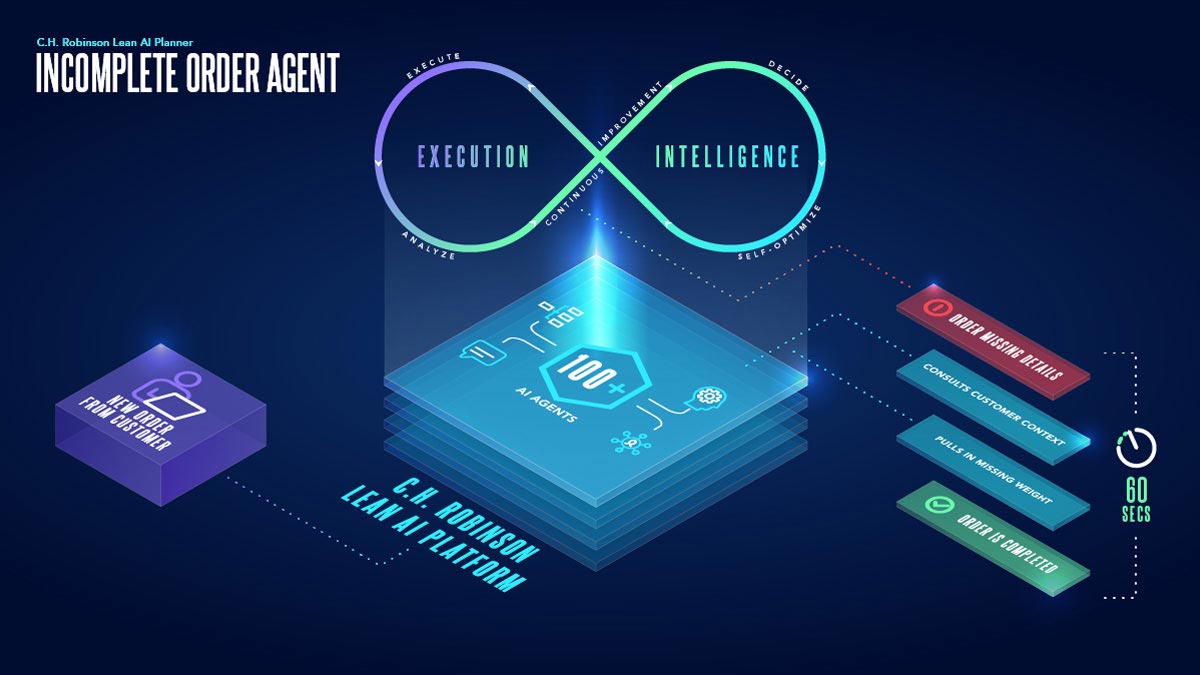
Using our Lean AI approach, C.H. Robinson has built AI agents specifically designed to identify and resolve missed pickups as they occur. When a pickup doesn’t happen as planned, the agent is automatically notified and immediately begins working behind the scenes—tracking shipment status, reaching out to carriers, determining next actions, and updating systems.
What once required hours of follow up now happens in moments. This shifts resolution from a reactive, manual process to a continuous, always on capability that supports both speed and transparency.
Today, these AI agents are working across hundreds of shipments every day for more than 11,000 customers, delivering measurable improvements:
- 95% of missed pickup checks automated, reducing manual intervention
- 350+ hours saved every day, freeing teams to focus on higher value work
- Shipments moving up to a full day faster, improving predictability
- 42% fewer unnecessary return trips, improving carrier efficiency and reducing waste
By applying purpose built AI to the unique complexity of LTL, the industry’s biggest challenges can be addressed at scale—unlocking more consistent, reliable service over time.
Innovating for a new era of freight classification
While execution issues like missed pickups can disrupt freight, many challenges originate earlier—at classification. In LTL, freight classification is foundational to pricing, planning, and handling, yet it has historically been complex. That complexity intensified in 2025 when the National Motor Freight Classification (NMFC) system underwent one of the most significant overhauls in its history.
With thousands of updates, additions, and structural changes, shippers faced a more dynamic and unfamiliar classification environment that introduced new risk at the point of order creation. Even small inaccuracies in classification can lead to outsized downstream impacts, including carrier inspections, re-invoicing, unexpected charges, and added coordination across partners.
Recognizing this shift before it took effect, C.H. Robinson took a proactive approach—developing an NMFC Classifier Agent in advance of the 2025 changes to help shippers adapt with greater ease. The agent helps determine the correct freight class and code in real time and works alongside other AI agents to transform unstructured tenders, such as those received via email, into complete and accurate orders from the start.
This early investment enabled immediate impact as the new system rolled out:
- Determines freight class and code for 2,000+ orders per day
- Saves 300+ hours of manual work daily
- Reduces delays at order creation, helping freight move faster
By addressing classification at the source, the NMFC Classifier Agent helps shippers stay ahead of a complex industry transition, reducing disruption and keeping freight moving smoothly through an evolving LTL landscape.
Preparing LTL networks for what’s next
The future of LTL isn’t about removing complexity—it’s about managing it with greater intelligence, visibility, and intent.
Progress in LTL shows up as networks recover faster from disruption, deliver more predictable outcomes, and adapt more easily as conditions evolve. When operational expertise is paired with smarter systems, freight moves with greater confidence.
That’s how LTL continues to evolve: not through isolated fixes, but through system-level improvements that steadily raise the bar for reliability across the supply chain.